Israelis Cast Ballots in Tight Race to Decide Netanyahu's Fate
With polls showing a deadlock, voters head to the polls to choose between Prime Minister Netanyahu and his rival, Gadi Eisenkot, in a vote that will likely trigger months of coalition talks.
By Pedro Tanaka ·
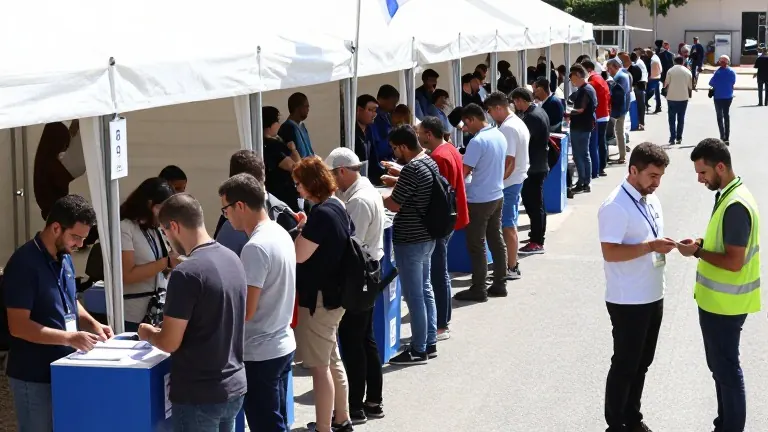
Israelis voted on Tuesday in a national election that many see as a direct test of Prime Minister Benjamin Netanyahu’s leadership following the Hamas-led attack on October 7, 2023. The vote determines who will form the next government in the 120-member Knesset, a body where no single party has ever secured a majority of 61 seats.
Opinion polls indicate a close contest with no clear winner, setting up a period of intense negotiations among roughly a dozen parties expected to cross the 3.25% threshold for representation. More than 7.3 million citizens are eligible to vote, including approximately 330,000 young Israelis who spent their high school years during the conflict.
In Jaffa, a mixed Jewish-Arab neighborhood of Tel Aviv, Haim Ron, 69, said he was voting for former military chief Gadi Eisenkot, Netanyahu’s main rival. “I believe we deserve a country with a good quality of life, where we can raise our children and grandchildren in peace and security,” Ron said. Another voter, Noa Sabban, described the election as being “about the last three years, and about the future we want for our children here.”
Emotions ran high at polling stations across the country. Noga Mizrahi, who traveled from the kibbutz Nirim, a site of the 2023 attack, called the vote critical. In Kiryat Shmona, a stronghold near the Lebanese border, a man tore down a poster of Eisenkot. Families of victims and former hostages observed a moment of silence in Tel Aviv. Yona Adam, whose son Mapal was killed in 2023, urged voters to “remember all those whose voices are no more.”
Mansour Abbas, the leader of the Islamist party Ra’am, voted in his hometown in the Galilee. Abbas suggested his party could become a kingmaker if neither major bloc secures a majority. “Our vote will change the government,” he said. However, Abbas claimed the arrests of at least three of his activists in the Negev Desert were an attempt to influence results. Police stated the arrests were based on suspicion of bribery and denied interference.
Itamar Ben-Gvir, the national security minister and a close ally of Netanyahu, also voted. He expressed hope that he might become defense minister, stating it would be good for the soldiers and the people of Israel. Eisenkot campaigned in Ofakim, a southern community attacked in 2023, where he vowed to dismantle Hamas’s governing force within 18 months of taking office.
By 10 a.m., the Central Elections Committee reported that 17% of voters, or about 1.2 million people, had cast their ballots. This early turnout is higher than the 70.63% recorded in the November 2022 election. Polling stations, numbering around 12,000, are set to close at 10 p.m. in most areas. Ballots are counted by hand at each location immediately after voting ends, with thousands of volunteer monitors and over 15,000 cameras in place to document the process.
Netanyahu, 77, has led Israel for nearly two decades. A loss could end his political career, while a win would solidify his status as a political survivor. U.S. President Donald Trump endorsed Netanyahu earlier in the month. The campaign focused on accountability for October 7, the exemption of ultra-Orthodox Jews from military service, and a 2023 judicial overhaul.
Source: WTOP News