France Integrates Ten European Allies into Nuclear Defense Network
Paris is building new infrastructure and deploying Rafale jets across the continent to address fading confidence in American security guarantees.
By Pedro Tanaka ·
European nations are increasingly looking to Paris for security guarantees as trust in Washington wanes. France is currently coordinating with ten partner countries to expand its nuclear deterrence capabilities across the continent, according to a report by the Wall Street Journal released on Monday.
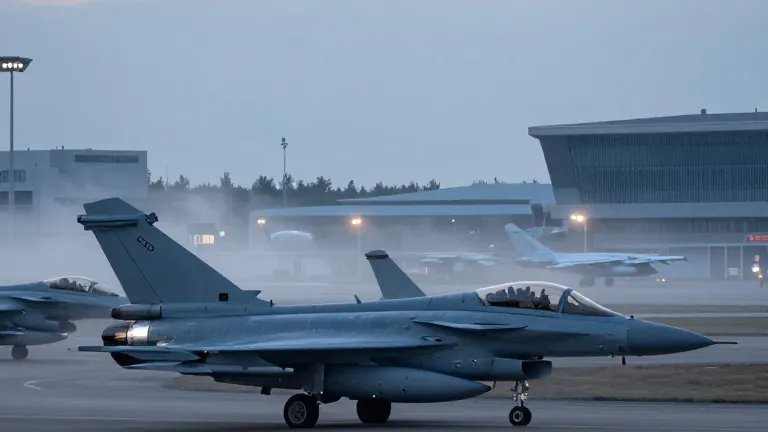
The initiative, labeled forward deterrence, involves constructing new infrastructure and establishing links for communications, early warning, and intelligence sharing. A key component of the plan is the deployment of French nuclear-capable Rafale fighter jets to various locations in Europe. The goal is to create a unified deterrent against potential Russian aggression without requiring a full alliance of all European states.
French President Emmanuel Macron announced the concept in March of this year. Since that announcement, the United Kingdom, Germany, Poland, the Netherlands, Belgium, Finland, Norway, Sweden, and Denmark have joined the effort to varying degrees. Rather than holding large group meetings, France has conducted separate one-on-one talks with each partner. Senior defense officials noted that this decentralized approach has required European nations to stay in constant contact with one another to compare what Paris has told each country.
Finnish President Alexander Stubb clarified the role of his nation in the pact. He stated that Finland has no plans to host nuclear weapons on its soil during peacetime but aims to create a strategic dilemma for Russia. Stubb described the process as a long-term commitment, estimating it will likely take ten to fifteen years to fully develop. He emphasized that access to information and involvement in planning are central to Finland's security strategy.
The push for a continental nuclear shield comes amid growing questions about American reliability. Doubts have intensified regarding whether Washington would risk nuclear war to defend a European ally, particularly as U.S. President Donald Trump pursues energy deals with Russian President Vladimir Putin and increases pressure on Ukraine. French officials argue their deterrent is more credible because Europe's security is a direct matter for Paris. Macron's adviser, Chatel, noted at the Warsaw Security Conference that France shares the same geography and economic continuity with its neighbors, a connection the United States does not possess.
Macron has stated that the survival of close partners affects French vital interests directly. Norwegian Foreign Minister Espen Barth Eide said the plan supplements existing nuclear guarantees from the United States rather than replacing them. France has also announced it will resume producing nuclear devices for the first time in decades and will make the size of its stockpile confidential. The nuclear force will remain entirely under French control.
One government minister from a partner country said France would allow participation in deterrence to a degree comparable to American arrangements. Officials indicated that keeping the nuclear force under French command was a strategic choice to make the strategy acceptable across the French political spectrum. This includes securing support from the far-right party of Marine Le Pen, which is currently polling ahead in the presidential race ahead of next spring's elections.
Source: The Jerusalem Post