Swift Telescope: NASA Ends 22-Year Mission as Spacecraft Reenters Atmosphere
The observatory’s orbit decayed due to solar activity, and a failed private rescue attempt in July preceded its descent near Indonesia.
By Lorenzo Patterson ·
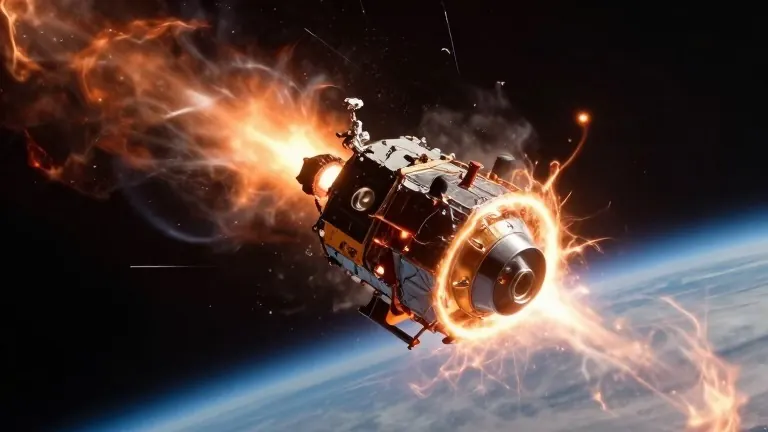
NASA concluded the operational life of the Swift Observatory on Wednesday as the spacecraft reentered Earth's atmosphere near Indonesia. The U.S. Space Force confirmed the descent after tracking the satellite’s sinking orbit, a decline accelerated by intense solar activity over the past few years.
The observatory weighed 1.5 tons. NASA anticipated that some of the denser components would survive the atmospheric burn, though the agency had not yet determined the exact mass that burned up. Swift launched in 2004 with a planned two-year mission to study gamma-ray bursts and exploding stars. It operated for 22 years, observing thousands of cosmic events and serving as a first responder for other telescopes.
The end of Swift’s mission follows a failed rescue effort by Katalyst Space. NASA contracted the private company to perform an orbit-boosting maneuver after the satellite’s trajectory began to decay. Katalyst launched a three-armed robotic craft in July, but the vehicle experienced technical issues and crashed in September. The failed intervention occurred less than three months before Swift’s final reentry.
NASA is now evaluating similar options for the Hubble Space Telescope. Launched in 1990, Hubble’s orbit is also being chipped away by solar storms. Recent analyses project that Hubble will reenter Earth by the mid-2030s if no corrective action is taken. The space agency is seeking input from private companies on how to boost Hubble’s orbit, upgrade its systems, or guide it to a controlled reentry.
Any proposed mission for Hubble must occur by 2032. Nicky Fox, NASA’s science mission chief, stated that the agency has more time to explore options for Hubble than it did for Swift. Unlike the rushed effort for Swift, NASA can now deliberate on industry proposals without the same time pressure.
NASA Administrator Jared Isaacman emphasized the value of extending Hubble’s operational life. “Hubble still has important science ahead of it,” Isaacman said in a statement. He added that the agency should look at every reasonable opportunity to keep the telescope delivering data for as long as possible.
Source: Main Line Media News
More Business · Business Complaints · Report a business · Got a Story?