Monsoon rains swamp Southwest, forcing evacuations and altering voting plans
Record rainfall has isolated towns from Pagosa Springs to Flagstaff, prompting emergency measures for Election Day and disrupting local infrastructure.
By Nikolai Morales ·
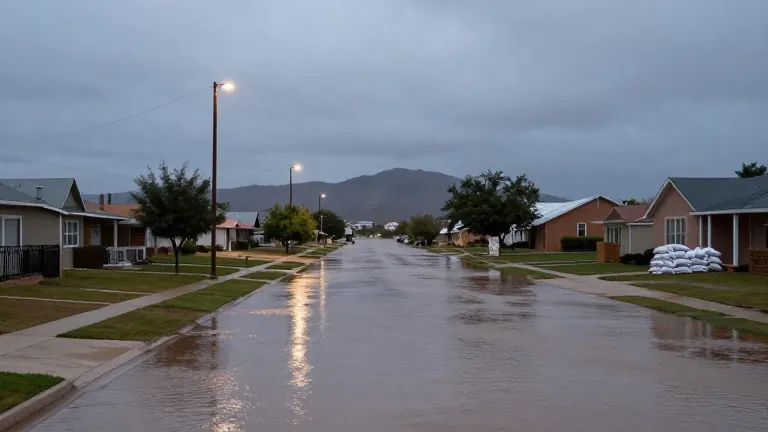
Residents across the Southwest faced isolation and displaced water on Monday as heavy rains turned dry creek beds into fast-moving rivers. The storm system forced hundreds to evacuate their homes and required swift-water rescue teams to operate continuously in multiple states. One person died in the flooding, while police in Flagstaff, Arizona, suspect a second death was weather-related.
The National Weather Service estimated that up to four inches of rain fell across the Four Corners region of New Mexico, Arizona, Colorado, and Utah. Former National Oceanic and Atmospheric Administration chief scientist Ryan Maue calculated that more than 20 trillion gallons of rain have struck the Four Corners states and Nevada in the past two weeks. Meteorologist Jennifer Tate noted the system was broad rather than localized, bringing substantial precipitation to many areas simultaneously.
Pagosa Springs, Colorado, which has a population of about 2,000, experienced severe flooding after the San Juan River crested at 16.81 feet late Sunday night. Officials had warned of potentially catastrophic conditions following a similar event in 1911. The town had lifted an evacuation order last week but reimposed it Saturday. Deanna Chiappetta, a resident, described her neighborhood as Aspen Springs Island after bridges became impassable. She expects the town to remain largely cut off due to damaged roads and bridges.
Election Day logistics were adjusted to accommodate displaced voters. The Colorado Secretary of State's office stated that residents of Pagosa Springs who received ballots by mail can obtain replacements at any vote center in the state. Mail ballots can be returned to any drop box or vote center in Colorado by 7 p.m. on Election Day. In-person voters outside their home county may only cast ballots for statewide races.
In Durango, Colorado, police Chief Brice Current said authorities were checking on residents who stayed in their homes along the Animas River. The river was closed to recreational watercraft due to sewage and chemicals in the water. Greg Ewing, a local volunteer, helped remove several feet of mud from neighbors' yards. He noted that the community came together to help.
Record rainfall was reported in Arizona, including 7.3 inches at Workman Creek near Phoenix. Flagstaff recorded 5.15 inches over two days, contributing to its wettest November 1 ever. A man, identified as Williams Singavarapu, 73, was found dead in a drainage area after falling into floodwaters. In Sedona, officials ordered evacuations near Oak Creek as floodwaters trapped residents. A section of the main highway between Flagstaff and Sedona was washed out, leaving boulders and trees on the road.
Ryan Benally, a professor at Utah State University, spent the weekend building dirt berms to protect his parents' home near Montezuma Creek, Utah. His parents, both in their 60s, said they had never seen flooding this severe. Benally coordinated deliveries of bottled water and supplies to shelters, noting that emergency access routes for some remote residents had washed out. The village of Chama, New Mexico, was evacuated and cut off by road closures as the San Juan River continued to rise.
Officials in the Pinetop-Lakeside area of central Arizona reported manhole covers popping up as sewage backed into homes. Weather service meteorologist Aaron Hardin said Tucson received two to three months of rain in a couple of days. The Jemez River in New Mexico rendered campgrounds and fishing sites inaccessible. The San Juan River in New Mexico was expected to crest between Tuesday and Wednesday.
Source: WTOP News