Israel Election Leaves No Majority
Netanyahu’s camp holds 53 seats, but double-envelope ballots and coalition math keep the final government unclear.
By Nikolai Morales ·
Israel’s election count reached a standstill on Wednesday evening as neither political bloc secured the 61 seats required to form a government without external support.
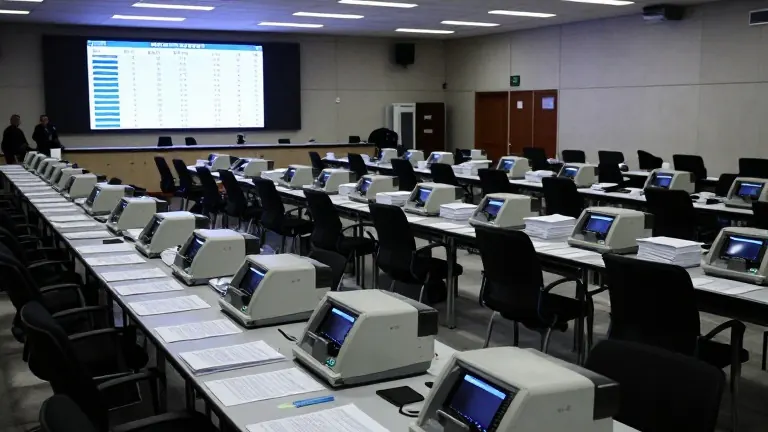
The Central Elections Committee reported that Benjamin Netanyahu’s bloc was projected to win 53 seats, while the opposition bloc was projected to take 48. More than five million votes from Tuesday’s election had been counted at that point. The official tally stood at 88% and excluded double-envelope ballots, which were scheduled for counting overnight.
Likud, Netanyahu’s party, was projected to win 26 seats, securing its position as the largest party in the Knesset. United Torah Judaism, Shas, and Otzma Yehudit were each expected to take seven seats, while the Religious Zionist Party was projected to win six. These results differed from pre-election television polls that had shown Likud with considerably fewer seats.
In the opposition camp, Gadi Eisenkot’s Yashar party was projected to win 21 seats. Naftali Bennett’s B’Yachad was expected to take 12, Yair Golan’s The Democrats eight, and Avigdor Liberman’s Yisrael Beytenu seven. Ofer Winter’s People of Israel and Yoaz Hendel’s The Reservists-Economic party were both projected to miss the 3.25% threshold for entry into the Knesset.
Arab parties won a record combined total of 19 seats according to the last count. The Joint List was projected at 12 seats, and Ra’am at seven. High turnout among Arab voters prompted Likud to accuse Arab parties of election fraud, bribery, intimidation, and ballot manipulation. The party demanded an immediate investigation by law enforcement.
President Isaac Herzog urged leaders to consult with open minds to avoid another round of elections. "We must do everything, certainly after yesterday, to avoid another round of elections," he said. Yair Golan said he would meet with three opposition leaders on Thursday. He argued that the opposition could form a government with Arab parties, noting that the opposition had 65 seats including those parties compared to Netanyahu’s 55.
A unity government between Netanyahu and Eisenkot appears unlikely, as Eisenkot has refused to serve under Netanyahu, even in a rotation. Other opposition leaders have ruled out joining a Netanyahu-led coalition. A minority government that wins a confidence vote without 61 seats remains a possibility, potentially with Arab party support. Joint List chairman Yousef Jabareen said his party was ready to "pave the way for the ousting of the Netanyahu government."
MK Ahmad Tibi stated the opposition could form a government "if it has the courage." Bennett, whose 2021 government included Ra’am, has since taken a firm stance against including any Arab faction in a future coalition. The president must consult Knesset factions before choosing who will attempt to form a government.
Source: The Jerusalem Post