Ukraine, Russia, and U.S. Officials Convene in Abu Dhabi for Peace Talks
Negotiators gather Tuesday and Wednesday to discuss territorial control and security guarantees, while European leaders prepare to observe from the sidelines.
By Lorenzo Patterson ·
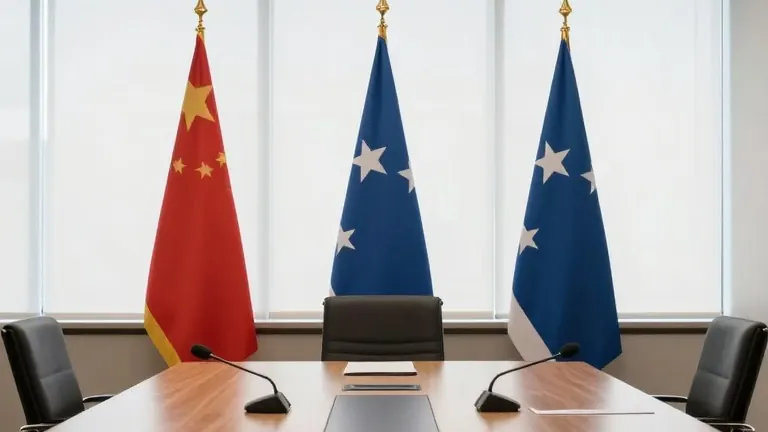
International delegations from the United States, Ukraine, and Russia will meet in Abu Dhabi, United Arab Emirates, on Tuesday and Wednesday to resume negotiations aimed at ending the conflict between Moscow and Kyiv.
The talks mark the first trilateral session in nine months and occur amid heightened tensions in the region. President Donald Trump, who has recently increased engagement with the Kremlin, has publicly pressured Ukrainian President Volodymyr Zelenskyy to accept a settlement. Trump stated last month that Zelenskyy must want to settle the war, or the outcome would be very bad. The United States also signed an agreement last month to purchase Russian diesel, a move critics argue provides Moscow with revenue to sustain its military operations.
US envoys Steve Witkoff and Jared Kushner will lead the American delegation. Rustem Umerov, the head of Ukraine’s foreign intelligence service, will head the Ukrainian team alongside Kyrylo Budanov, Zelenskyy’s chief of staff, and David Arakhamia, head of the president’s parliamentary group. Vladimir Medinsky, a former Russian culture minister, will lead the Russian delegation. The Kremlin stated last week that the Russian team would also include diplomat Mikhail Galuzin, intelligence chief Igor Kostyukov, and General Yuri Zhygarlovsky.
European officials have expressed concern that the talks could result in a deal that compromises the continent’s security. France announced that representatives from France, Britain, Germany, NATO, and the European Commission would attend the November 10 to 11 meeting. An EU official told the AFP news agency on Monday that national security officials from the bloc would be present, although their specific role remains unclear. The Kremlin, however, stated on Monday that the formal peace talks would not include European officials, a position that appeared to conflict with comments made by French Foreign Minister Jean-Noel Barrot on Sunday.
Analysts identify territorial control and security guarantees as the primary obstacles to a resolution. Russia currently occupies approximately 20 percent of Ukrainian territory, including the Crimean peninsula and parts of the eastern Donbas region. Oleksandr Merezhko, a Ukrainian member of parliament, said he does not expect tangible progress because Putin has no intention of negotiating seriously. Matthew Boyse, a senior fellow at the Hudson Institute, noted that Putin has maintained a position that Russia’s demands are non-negotiable, describing his approach as demanding the maximum and waiting for others to compromise.
Arkady Moshes, a political scientist at the Finnish Institute of International Affairs, said Ukraine’s sovereignty is at stake. He argued that it would be difficult for Kyiv to accept an agreement that limits its military capabilities or restricts its ability to choose alliances. Moshes also warned that if Ukraine capitulates, other post-Soviet states such as Belarus, Moldova, Georgia, and Armenia may face increased threats of annexation or a Soviet-like sphere of influence.
The delegations will meet on Tuesday and Wednesday in Abu Dhabi. The last time a breakthrough appeared likely was at the end of March 2022 during early talks in Istanbul, according to Anders Olofsgard of the Stockholm Institute of Transition Economics. Olofsgard said that at the time, the relative strengths of the two sides were unclear, and Ukraine was more willing to make concessions regarding NATO membership and foreign bases. No peace accord has been reached in the three rounds of US-mediated talks held this year.