Transportation Secretary Blames Contractor for Longest Ground Stop Since 2001
A faulty router installation in Arkansas triggered a four-hour nationwide air traffic halt, prompting a $50 billion funding request to Congress.
By Nikolai Morales ·
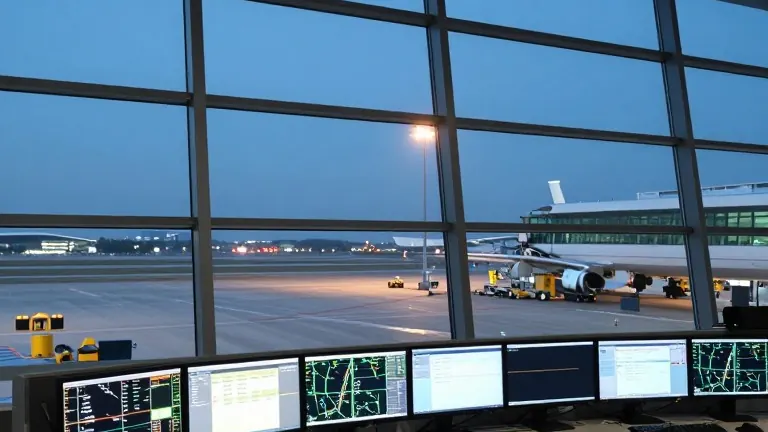
More than four hours of suspended air traffic marked the longest nationwide ground stop since the terrorist attacks of September 11, 2001. Transportation Secretary Sean Duffy stated that the duration of the outage would likely have been shorter if the contractor had identified the technical failure more quickly.
The disruption began Friday when a newly installed router at a key air traffic control facility started sending thousands of connection attempts. This equipment was part of a project to replace old copper wiring with fiber optic lines in Arkansas. Duffy told the 2WAY streaming platform’s “The Morning Meeting” show on Wednesday that L3Harris, the company responsible for the work, failed to isolate the issue promptly. He noted that officials are now working to fix the network monitoring protocols that allowed the problem to persist.
Investigators are currently testing the Juniper router to determine why it malfunctioned differently from units installed in 68 previous projects across the Federal Aviation Administration network. The probe focuses on whether an experienced technician misconfigured the device or if it was defective. The router manufacturer stated it believes the device functioned exactly as the installer configured it.
The current failure mirrors a 2009 incident where a Harris technician incorrectly set up a router during similar fiber optic work. That 2009 event caused 820 delayed flights. Harris merged with other companies to become L3Harris, which has maintained the FAA network for decades. Matthew Hampton, the former assistant inspector general for aviation, said the agency has a long history of weak oversight over its contractors.
FAA Administrator Bryan Bedford acknowledged the agency’s ultimate responsibility for the outage. Speaking at an event hosted by The Hill on Wednesday, Bedford told reporters to direct their criticism to him rather than the secretary. He described himself as the chief accountability officer and said he takes full responsibility for the incident.
The FAA recently doubled its funding request to Congress to $50 billion to complete the overhaul of the air traffic control system. Last year, Congress approved $12.5 billion for the initial phase. Bedford admitted that lawmakers may face difficulty approving the new total, particularly since the FAA has not yet spent all of the previous allocation. Duffy explained that unspent funds remain because the new radars and systems are still under construction.
Of the $50 billion request, only about $10 billion is designated for air traffic control technology. The remaining funds would cover upgrades to runways, airport towers, and air traffic control centers built in the 1960s. Several key lawmakers indicated on Tuesday that Congress is unlikely to approve the full amount immediately.
Chris Sununu, president of the Airlines for America trade group, praised Bedford for maintaining communication with airline leaders during the outage. Sununu said Bedford held three or four conference calls with CEOs and operations staff throughout the stop. Sununu warned that further technical issues are likely during the upgrade, comparing the modernization to connecting an iPhone with a flip phone.