New gas readings suggest Mars still has active volcanic systems underground
A European space probe detected hydrogen chloride near a Martian volcano, indicating that molten rock may still be heating subsurface water.
By Nikolai Morales ·
Scientists have found chemical evidence that Mars remains geologically active beneath its frozen surface. A team of researchers published findings in Science Advances on Wednesday, reporting that a specific gas is still leaking from the planet. This discovery suggests that liquid water may still exist in underground pockets, creating environments where simple life forms could potentially survive today.
The detection came from the European Space Agency’s ExoMars Trace Gas Orbiter. The spacecraft uses a camera instrument called CaSSIS to monitor the Martian surface. In 2021, scientists first noticed tiny traces of hydrogen chloride in the atmosphere. Hydrogen chloride is a corrosive gas that irritates human skin. On Earth, this gas is released by active volcanic vents. The presence of hydrogen chloride on Mars implies that magmatic processes are still occurring under the surface, even though the planet appears dry and cold from orbit.
Professor Daniel Mège, a Mars researcher at Poland’s Academy of Sciences and co-author of the study, explained the connection to life. “Hydrothermal systems are known on Earth for being the main, or one of the main environments where life emerged,” Mège said. “On Mars it could be the same.” These hydrothermal systems involve hot fluids moving through the ground, driven by heat from magma. The chemical reactions in these systems can produce the ingredients necessary for life. If such systems are still active on Mars, they could have supported bacteria in the past or may still be doing so now.
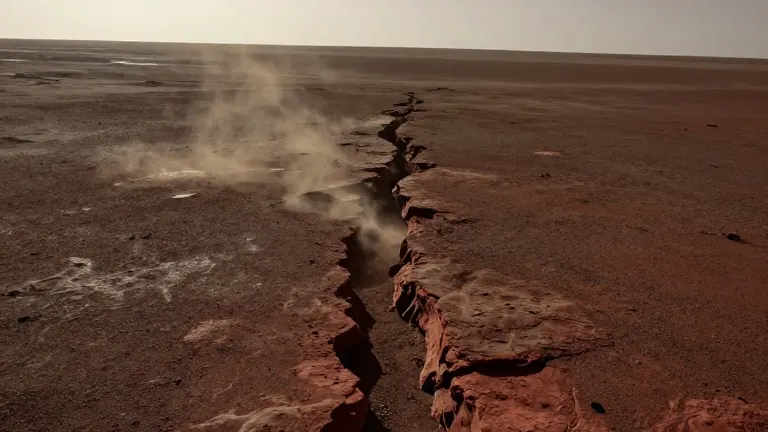
The data shows that the gas levels fluctuate with the seasons. Hydrogen chloride concentrations peak during the Northern Hemisphere winter, a period that lasts 154 Martian days. The gas almost disappears during the summer months. While dust and water cycles on Mars explain some atmospheric changes, the gas remained consistently near volcanic fissures on Alba Mons, a volcano in the Northern Hemisphere. The research team used the orbiter’s camera to identify fresh, narrow cracks in the rock. Some of these fissures are hundreds of meters long. The consistent link between the gas and these specific geological features supports the theory that molten rock is still churning below.
Colin Wilson, a planetary scientist at the ESA, noted that the magma could melt ice to create habitable niches. “If these gas emissions are occurring until the present day, perhaps Mars may have been habitable more recently than previously thought,” Wilson said. However, Mège emphasized that the findings require further verification. He noted that generating life from existing materials takes time, ranging from hundreds of thousands to tens of millions of years. The planet’s crust must have remained stable long enough for these chemical processes to occur. To find definitive proof, future missions may need to dig into the surface, potentially reaching depths of 20 centimeters to 100 meters.
The study adds to the growing body of evidence that Mars was once home to flowing rivers and vast oceans. The red planet is now a dusty orb, but the new data suggests it is not entirely dead. The detection of hydrogen chloride near Alba Mons provides a concrete target for future exploration. If the gas is indeed coming from active hydrothermal systems, it changes the timeline for when Mars could have supported life. The next step is to confirm these observations with additional data from the orbiter and prepare for potential robotic missions to sample the subsurface.
Source: Metro