Mars Cloud Reproduction Hinges on Humidity 100,000 Times Earth's Levels
Researchers at Sorbonne Université modeled the Arsia Mons Elongated Cloud only after adding a nucleation process never observed in a planetary atmosphere.
By Nikolai Morales ·
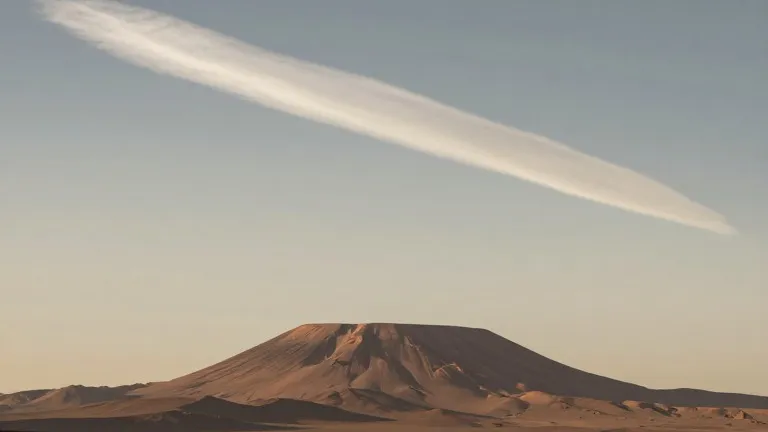
A cloud that forms each morning near the Martian volcano Arsia Mons stretches more than 1,000 miles before dissipating, a cycle that repeats through the planet's spring and summer. The feature, called the Arsia Mons Elongated Cloud or AMEC, grows through the morning until its length matches the straight-line distance from New York to Kansas City. A probe first recorded it in 2018.
A modeling study published in Nature Geoscience reports the first successful reproduction of the cloud's formation. Lead author Jorge Hernández-Bernal, a planetary scientist at Sorbonne Université in Paris, said in a press release that the simulations ran only after researchers added what he called "exotic physics." The process, homogeneous nucleation, forms ice crystals directly from vapor without dust or salt particles to seed them. "Once we included this physics in our simulations, the AMEC emerged just as we hoped," Hernández-Bernal said. He compared the mechanism to condensation appearing in the middle of a room rather than on a window, calling it "wholly unexpected."
The conditions required are severe: a temperature drop of 30 degrees Celsius within 10 minutes, plus high relative humidity. Arsia Mons itself generates those conditions. Wind striking the 65,000-foot volcano produces a wave that lifts moist air high into the atmosphere within minutes. The humidity threshold the model requires exceeds any value ever measured on Earth by more than 100,000 times, according to the study.
Scientists have assumed for years that this kind of nucleation could occur in the upper atmospheres of Venus and Earth, but no observation has confirmed it. Researchers also lacked evidence that such humidity levels existed on Mars. Hernández-Bernal said far less is known about the Martian atmosphere than Earth's, which he called the reason reproducing the cloud to this degree is difficult. "The result is remarkable," he said.
The AMEC appears during Martian spring and summer and dissipates each morning after growing longer through the early hours. The study does not address whether the same nucleation process occurs in other planetary atmospheres.
Source: Wired