Sorting Paper Clutter Without the Stress: A Professional Organizer's Advice
Veteran organizer Kacy Paide says tackling piles of paperwork is easier when people work at their own pace, start with the closest stacks and build a filing system they will actually use.
By Lorenzo Patterson ·
Piles of mail on the kitchen island, a closet stuffed with tax records and product manuals, and no idea where the Social Security card ended up. For many households, that is the state of the paperwork. Professional organizer Kacy Paide, who has spent more than two decades helping clients with paper clutter, says the process does not have to be overwhelming.
Her central advice is to ease the pressure. Nobody has to rush or follow a prescribed method. "You're in control of your paper, and it's up to you how fast you want to get through it," she says.
Paide recommends beginning with whatever is closest, such as the stacks around a desk or dining table, rather than worrying about boxes in the garage or office closet. "The documents and action items that are on fire tend to be closest to us," she says.
From there, she suggests splitting everything into two piles: active and inactive. Active papers need follow-up, such as a phone call or a bill payment. Inactive ones do not, and include receipts, birth certificates and sentimental items like a Valentine's Day card from a parent. Inactive papers can be filed right away or set aside until there is time for a closer look.
For active items, Paide makes the deadline obvious. She writes it in bold permanent marker on a sticky note and attaches it to the document. She advises being specific, with wording like "due by Nov. 15" or "start no later than 12/1," because labels such as "urgent" or "due now" lose their meaning over time.
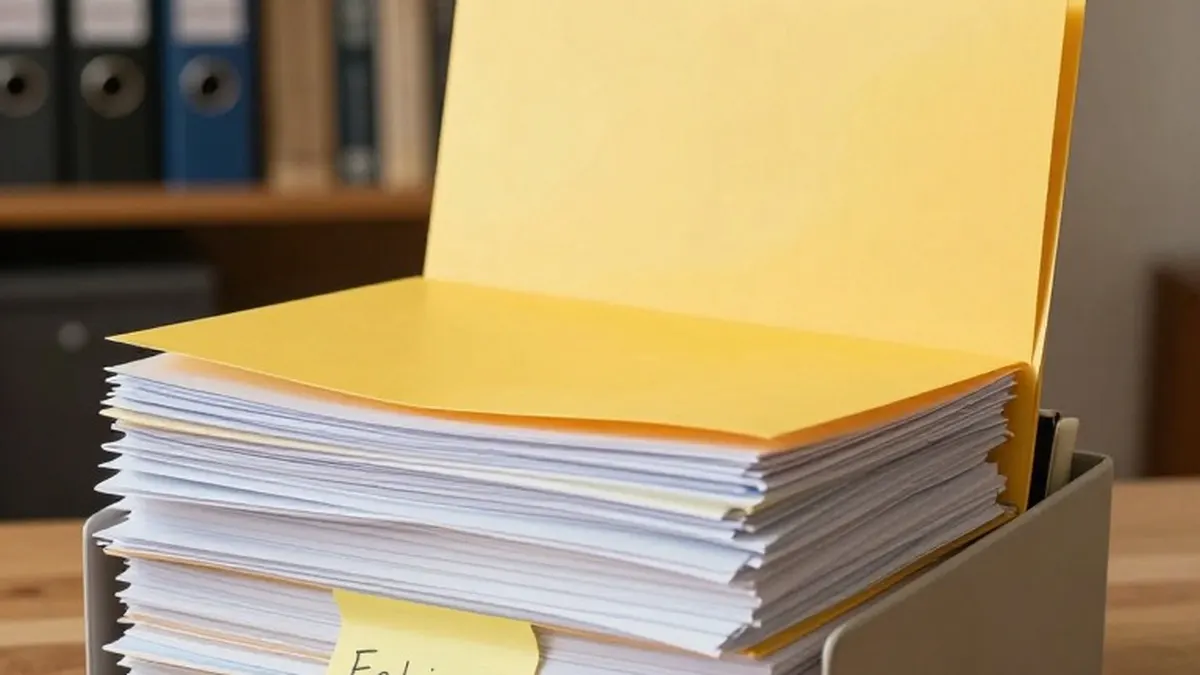
When it comes to storage, the right system is simply the one a person will use. Alphabetizing, color-coding and label-making are all optional. Paide does have preferences, though. She keeps the most vital documents, including passports and a marriage certificate, in a brightly colored folder placed at the front or back of a file box, acting as a "bookend to your filing system" so it is easy to find. She uses plain file folders labeled with sticky notes so the folders can be reused if her sorting approach changes, and she likes attractive file boxes displayed on bookshelves.
Not everything deserves space in a drawer. Paide suggests asking, "Under what circumstances would I need to produce this document?" She also notes that shredding everything with a name and address is unnecessary, even though some people feel they must do so to rest easy. According to the Federal Trade Commission, anything with sensitive information should be destroyed to guard against identity theft, including account numbers, birth dates, passwords and PINs, signatures and Social Security numbers.
For emotionally difficult papers, such as old letters, divorce papers or greeting cards, Paide recommends enlisting a family member or friend. Talking through one's thoughts aloud helps, and in her experience people decide whether to keep or toss such items "shockingly fast."
Finally, there is no need to finish in one go. Paide suggests working in 25-minute sessions if necessary, and reminds people that organizing is an ongoing process that requires upkeep and change.
Source: NPR
More News · National news · Report a business · Got a Story?