TSA Liquids Rule Forces Travelers to Check Gravy and Cranberry Sauce
The 3.4-ounce limit applies to spreadable holiday foods, forcing millions of flyers to move key Thanksgiving dishes from carry-ons to checked bags this week.
By Lorenzo Patterson ·
Millions of Americans are preparing to fly home for Thanksgiving, but the Transportation Security Administration has clarified a strict limit on liquid-heavy holiday foods that will force many travelers to restructure their luggage. The conflict lies in the agency's application of the 3-1-1 liquids rule to common savory and sweet condiments. Under this standard, any food item that can be spilled, spread, sprayed, pumped, or poured is classified as a liquid. If such an item exceeds 3.4 ounces, it cannot be carried in a standard carry-on bag and must be placed in checked baggage.
The rule creates a specific logistical challenge for traditional Thanksgiving meals. While solid foods are generally permitted in carry-on containers, the most iconic sauces and spreads on the holiday table fall under the liquid definition. Travelers who pack gravy, cranberry sauce, or dips in containers larger than the 3.4-ounce threshold must check their bags to bring these items on board. This requirement applies to both homemade preparations and store-bought jars or cans. The agency advises that these items be placed in checked luggage to avoid removal and potential disposal at the security checkpoint.
Specific items that trigger this liquid classification include gravy, whether homemade or commercially packaged in a jar or can. Cranberry sauce, whether prepared at home or purchased in a can, is considered spreadable and subject to the same limit. Wine, champagne, and sparkling apple cider also fall into this category. Canned fruits and vegetables are included in the list because the liquid inside the can counts toward the volume limit. Additionally, preserves, jams, jellies, and maple syrup must be checked if they exceed the size restriction. These items are distinct from solid foods like roasted turkey or mashed potatoes, which remain in the carry-on allowance.
Conversely, a wide variety of solid holiday foods are permitted in carry-on bags without restriction. The TSA allows travelers to bring baked goods, including pies, cakes, cookies, and brownies. Meats such as turkey, chicken, ham, and steak are allowed in any state, whether frozen, cooked, or uncooked. Stuffing is permitted whether it is cooked or uncooked, and whether it is packed in a box or a bag. Casseroles, fresh vegetables, and fresh fruits are also cleared for carry-on transport. This includes staples like potatoes, yams, broccoli, green beans, Brussels sprouts, cauliflower, beets, radishes, carrots, squash, and leafy greens. Fruits such as apples, pears, pineapple, lemons, limes, cranberries, blueberries, strawberries, bananas, and kiwi are similarly allowed.
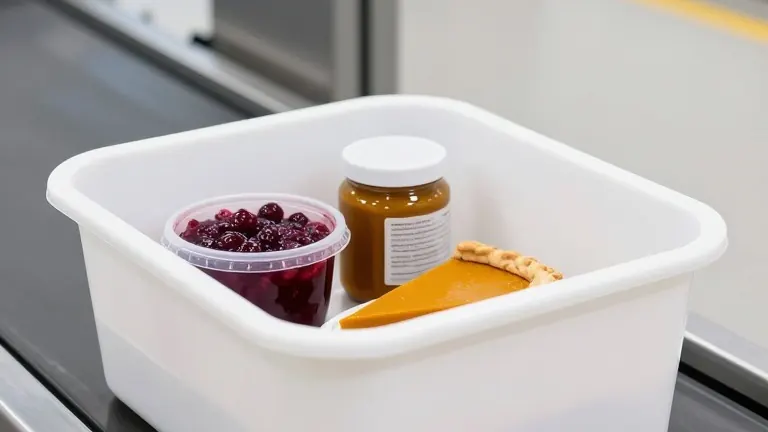
Travelers must follow specific procedures when bringing food through security checkpoints. Food items often require additional screening, so the TSA recommends placing them in an easily accessible location within the carry-on bag. At the checkpoint, these items must be removed from the bag and placed separately in a bin for screening. This step helps security officers process the items quickly and prevents delays for other travelers in the line. For those who need to keep perishable items cold during the flight, ice packs are permitted. However, the ice packs must be frozen solid and not melted when they pass through the security scanner. If an ice pack is slushy or contains liquid water, it is subject to the same liquid rules as other beverages and sauces.
The final decision at the checkpoint rests with TSA officers, who have the authority to determine whether an item meets the solid or liquid criteria. Travelers are advised to check the agency's website, tsa.gov, before their flight to verify current guidelines. For those traveling internationally, additional rules from the destination airport may apply, potentially varying from domestic standards. The agency emphasizes that keeping perishables chilled and understanding the liquid definitions will help ensure that holiday dishes arrive at the destination in the same condition they were packed in. The distinction between solid and spreadable foods is the primary factor in determining whether an item goes in the overhead bin or the checked bin.