Transit Authority Sets 2030 Deadline for New Bus Line and Station Overhaul
Metro plans to rebuild the Stadium-Armory station and launch a rapid bus corridor on H Street NE to handle surges in ridership for the new RFK Stadium.
By Lorenzo Patterson ·
The Washington Metropolitan Area Transit Authority has detailed plans to modernize east-west transit routes before the opening of the new RFK Stadium in Summer 2030.
Documents presented to the WMATA Finance and Capital Committee on Nov. 19 outline the scope of the Gold Line Bus Rapid Transit project. The agency also released concepts for structural upgrades at the Stadium-Armory station. Both initiatives aim to accommodate tens of thousands of daily commuters and event attendees.
The Gold Line Phase 1 will run along H Street NE and Benning Road NE. The route connects the Minnesota Avenue and Benning Road Metro stations to Farragut Square. A dedicated stop will serve the RFK campus. Metro and the District Department of Transportation are currently designing the corridor. A potential Phase 2 could extend the line westward to Rosslyn, Virginia.
Current conditions on the corridor present logistical challenges. Metro data indicates that buses average seven miles per hour due to congestion. Vehicles illegally park in bus stops at nearly twice the District average. DDOT classifies the area as a Tier 1 High Injury Network Corridor. Between 2021 and 2025, the corridor logged more than 1,200 crashes and 23 severe injuries. Half of those incidents involved pedestrians or cyclists.
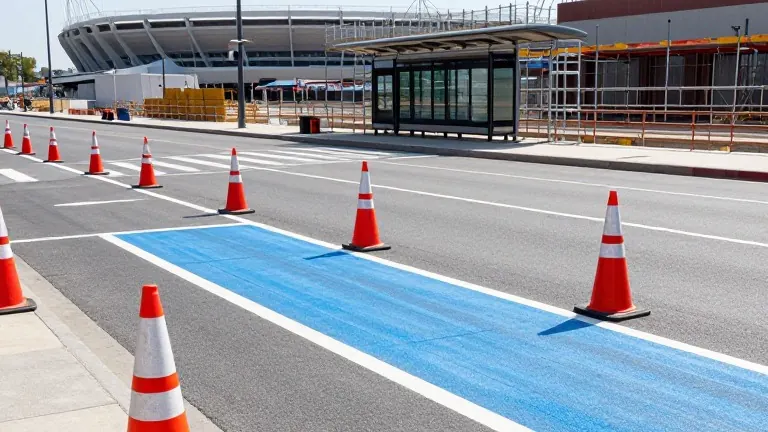
The proposed design includes 3.2 miles of new center-running bus-only lanes from Union Station to the RFK campus and 34th Street NE. This addition pairs with two miles of existing side-running lanes in downtown D.C. The plan calls for service every five minutes, with two-minute intervals to Union Station and three-minute intervals to the eastern termini during stadium events. Transit signal priority will be installed at roughly 50 intersections. Twenty station pairs will feature near-level boarding. A new transit plaza at RFK-Kingman Park will be served by 60-foot, three-door buses.
Metro projects the Gold Line will cut travel times between Farragut Square and the eastern stations by up to 30%. Average trip times would drop to 12 to 16 minutes. Daily ridership is expected to rise from current levels to 19,000 to 22,000 people. On event days, the line is designed to move more than 4,000 passengers per hour. Conceptual designs retain 80% to 90% of existing curb space for parking and loading along the main corridors.
The Stadium-Armory station requires expansion to handle the new 65,000-seat venue. Metro estimates that up to 38,000 attendees will use public transit for events. About 75% of those riders will travel west of the station. The agency plans to expand the north entrance and build a new interior mezzanine. Additional elevators, stairs, and faregates will be installed. Event-day management plans will include metering passenger entry and increasing staff levels.
The D.C. Council passed emergency legislation allocating up to $300 million for station upgrades and $5 million for the initial phase of the Gold Line. Mayor Muriel Bowser submitted the final draft of the broader redevelopment plan, which includes up to 6,500 new homes and 287,000 square feet of retail space. The district must identify funding for the Gold Line's final design and construction by April 2027.
Metro and DDOT are gathering public input on the concepts. An online survey is open on the WMATA website from Nov. 17 through Dec. 18, 2026. Officials will host a Community Open House on Nov. 30, 2026, from 6 p.m. to 8 p.m. at the Atlas Performing Arts Center on H Street NE. Construction on both the bus line and station upgrades is targeted to begin in Summer 2028.
The project schedule targets a Spring 2030 completion date. This timeline allows for a Summer 2030 launch alongside the stadium opening. Metro estimates the combined transit system will move about 27,000 people per hour from the area, clearing post-event crowds within 75 to 90 minutes.