Ancient Wildfires May Have Sparked Neolithic Pottery Making, Israeli Study Suggests
A new study proposes that intense wildfires and erosion in the southern Levant may have shown early farming communities how fire hardens clay, inspiring the invention of pottery.
By Journal Signal Staff ·
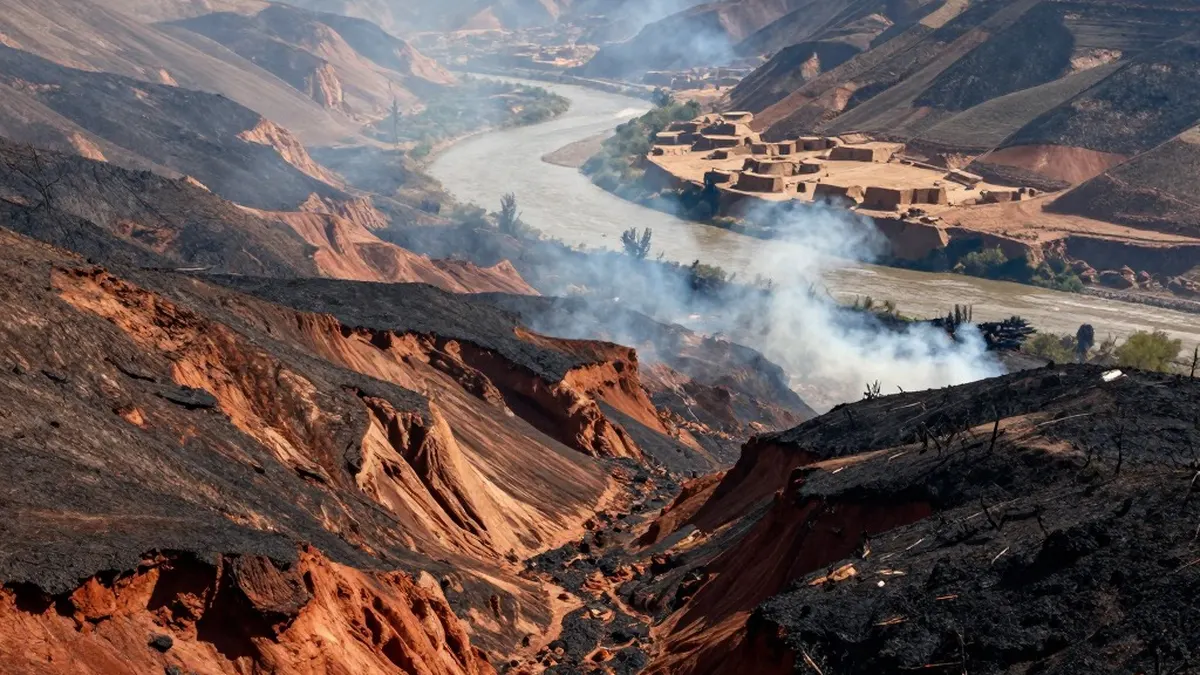
Intense wildfires and the erosion that followed them in the southern Levant may have helped Neolithic communities discover that fire could turn clay into pottery, according to a recent study.
The research, published in early September in the journal Geomorphology, draws on evidence from ancient sediment, caves, charcoal deposits and archaeological sites across the region to reconstruct how the Levant was shaped during two periods of major environmental instability.
Lead researcher Prof. Amos Frumkin of the Hebrew University of Jerusalem's Institute of Earth Sciences calls the idea the "natural kiln hypothesis." He proposes that Neolithic people may have learned that clay could be permanently hardened by fire after watching the same transformation happen naturally in the aftermath of severe fires.
The study compared two periods separated by more than 100,000 years. The first was the last interglacial period, known as MIS 5e, roughly 129,000 to 116,000 years ago. The second was the early Holocene, between approximately 11,000 and 7,000 years ago, when farming communities were becoming increasingly established in the region.
Evidence from both periods points to extensive wildfires followed by severe erosion. Tiny charcoal particles preserved in ancient lake sediments record peaks in burning, while chemical signatures in cave formations indicate substantial losses of vegetation and soil. During the early Holocene, the most intense episode appears to have occurred around 9,500 to 8,200 years ago.
Although people of the era used fire deliberately on a limited scale, Frumkin argued that the geographic extent and timing of the blazes point to climatic causes. Once fires burned away vegetation, exposed soil became vulnerable to rain and runoff, and clay-rich soil washed from hillsides into natural depressions such as the Jordan and Dead Sea valleys in large quantities. That process created fertile areas where farming communities could settle and flourish, and pottery appeared in the region during roughly the same broad period in which fires, erosion and clay deposition reached their peak.
Frumkin suggested that valley residents may have encountered patches of clay exposed to intense natural fires and noticed the heat had turned the soft material hard and durable, providing the basic idea behind intentionally firing clay. Earlier petrographic research supports the notion: Yarmukian pottery from the Jordan Valley was made from local redeposited terra rossa clay, the same material that would have accumulated around settlements after nearby hills eroded.
"A wildfire is normally seen only as a catastrophe, but environmental disruption can also expose people to new materials and new possibilities," Frumkin said. "Neolithic communities in the Jordan Valley may have watched fire transform the clay beneath and around their settlements and realized that this process could be reproduced deliberately." He added that one of humanity's most important technologies may have emerged partly from people learning to imitate what nature had already shown them.
The last interglacial served as what Frumkin described as a natural control experiment. The southern Levant then experienced an even more extreme combination of fires, vegetation loss, erosion and clay deposition, yet pottery did not appear, because the region's inhabitants lacked the cognitive abilities, knowledge and social conditions of later Neolithic communities.
Frumkin stressed that the natural kiln hypothesis remains "speculative and testable" rather than a proven account of pottery's invention. While major fires, clay deposition and the emergence of pottery clearly occurred within the same broad period, current dating methods cannot yet establish the exact sequence of events.
Source: The Jerusalem Post