Canada's top court set to rule on Quebec law banning religious symbols for public workers
Navien Waly lost her school volunteering role under Quebec's expanding restrictions, and a Supreme Court ruling on Friday will decide the fate of the law at their core.
By Nikolai Morales ·
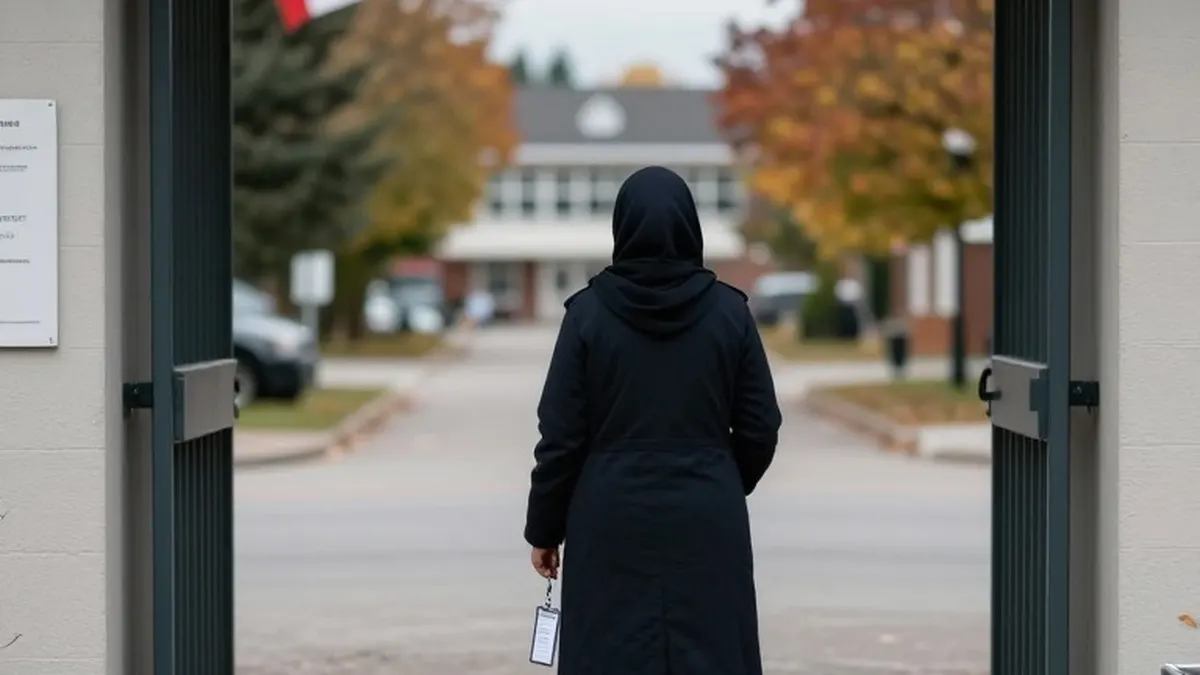
For ten years, Navien Waly volunteered at her children's schools in Quebec, helping at bake sales and sitting on graduation committees. Then an email arrived telling her she was no longer welcome. Under provincial law, it explained, parents who wear religious symbols could no longer volunteer. Waly, a Canadian-born mother of three, had started wearing the hijab four years earlier, at age 40, and the message felt like a "slap in the face." Her two younger children, used to seeing their mother at school, wanted to know what she had done wrong. "I'm the same person I was 10 years ago," she said. "It doesn't make me any different. I've never spoken about my religion."
The law also derailed Waly's return to work. Now 45, she had left a career in finance to train as a specialised educator and was due to start next year. Instead, she says, she cannot do the job she trained for as long as she keeps wearing the hijab.
The email to Waly traces back to Bill 94, which widened restrictions Quebec first imposed under Bill 21 in 2019. On Friday, Canada's Supreme Court is set to rule on a challenge to that earlier law, which bars public school teachers, police officers and certain other public officials from wearing religious symbols at work. The judgment could also define how far governments may go in using a provision of the Charter of Rights and Freedoms to shield laws from certain rights challenges.
In the seven years since Bill 21 passed, religious minorities across Quebec have felt its impact, and Muslim women in particular. In a survey of 411 Muslim women conducted in 2022 and 2023 for a report by the National Council of Canadian Muslims and York University researcher Nadia Hasan, 73 percent said the law had affected their job search, and 48 percent believed they were denied work because of their religious identity. Some women remove their hijabs when they arrive at work and put them back on when they leave, said Stephen Brown, the council's chief executive, describing a routine some called humiliating. Forcing people to choose between "your livelihood or your most deeply held convictions", he said, "was a dehumanising and cruel situation to inflict on people."
The effects reach beyond employment. In the same survey, 88 percent of Muslim women said the law had made Quebec a less welcoming place to live, and Brown said some Muslims in the province compare the climate to France, where it is "open season on Muslims." Waly said she has faced hostility she never experienced before, including a recent incident at a grocery store checkout where a man behind her sang that immigrants had ruined his life and cost him his job. Strangers have told her to "go back to your home." Her reply: "What home? This is my home."
Brown said many English-speaking Muslim Quebecers who can work elsewhere have left the province or plan to, while those who speak only French find relocating far harder. Waly has been urged to move too, but her father, brothers, nieces and nephews all live in Quebec. "You can't, after living here for 45 years, to just uproot your whole life."
Quebec's government presented Bill 21 as a moderate answer to a secularism debate rooted in the 1960s Quiet Revolution, when the province took control of schools and hospitals from the Catholic Church. A commission led by Gerard Bouchard and Charles Taylor later recommended barring religious symbols only for judges, police and others who wield the state's coercive power. The Coalition Avenir Quebec government went further, covering public school teachers while grandfathering those already in their posts. Premier Francois Legault defended the law days after it passed, saying the majority had felt ignored for years and that "to avoid extremes, you have to give a bit to the majority." Polling before passage found 64 percent support in Quebec. Brown argues the legislation, crafted during an election campaign, exploited distrust of organised religion, anti-Muslim sentiment and anxiety about the future of French-speaking culture to win votes.
Quebec has since broadened the rules. Bill 94, passed in 2025, extended the ban to school support staff and volunteers, including parents like Waly, required students to keep their faces uncovered and barred prayer on school premises. Earlier this year, Bill 9 covered daycare staff, banned face coverings at public colleges and universities and restricted campus prayer. The newly elected Parti Quebecois has pledged to bar elementary school students from wearing religious symbols.
At stake on Friday is Quebec's use of the notwithstanding clause, which lets a government keep a law in place even if it violates certain Charter rights, including freedom of religion and equality, for renewable five-year terms. Quebec renewed it in 2024, citing the need to preserve "social peace." A Quebec court found in 2021 that the law infringed the rights of people who wear religious symbols but upheld most of it because of the clause; the Quebec Court of Appeal affirmed that ruling in 2024 while reversing an exemption for English-language school boards. The Supreme Court heard the case in March. The National Council of Canadian Muslims, the Canadian Civil Liberties Association and the World Sikh Organization argue the law violates constitutional rights regardless. Brown said the clause "is supposed to be an extraordinary power of last resort" and should not shield governments "deliberately targeting the rights of citizens for political gain."
Waly is not optimistic the court will overturn the law, but hopes she will not have to start over. "At 45 years old, to start thinking of another path? I don't know what I'm going to do," she said. She worries most about her children. Her oldest daughter has talked about wearing the hijab one day but is now weighing it against the careers she may want. As her daughter put it: either give up the positions she cannot hold, or do not wear the hijab. "It's just kind of up in the air," Waly said. "I don't have an answer for that."