US Intelligence Chief Defends Trump's Bond With Putin
Director of National Intelligence Jay Clayton justified President Trump's description of Vladimir Putin as a friend while clarifying that the personal rapport does not equate to US support for Russia in Ukraine.
By Pedro Tanaka ·

United States Director of National Intelligence Jay Clayton has come under scrutiny to explain President Donald Trump's assertion that Russian President Vladimir Putin is his friend. During a recent appearance on the ABC News program This Week, Clayton addressed the political tension surrounding the president's warm tone toward his Russian counterpart. The comments follow a significant diplomatic event involving the leaders of the US, Russia, and China.
Journalist Jonathan Karl directly questioned Clayton during the interview, asking if Putin could truly be considered a friend to America given Trump's previous reluctance to answer the question definitively. Clayton responded by characterizing the recent meeting as historic and deemed the president's remarks appropriate. However, the intelligence chief made a clear distinction between personal rapport and geopolitical alignment, stating that Putin is not America's friend in the context of the war in Ukraine.
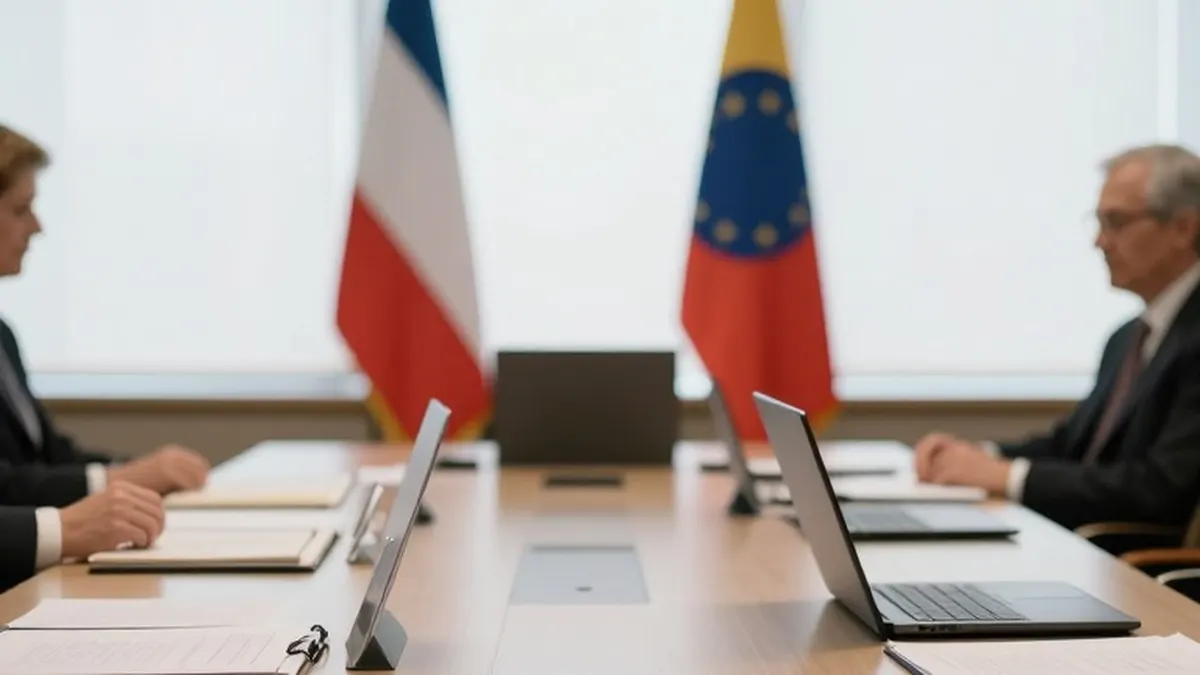
The public debate stems from the first confirmed trilateral meeting between Trump, Putin, and Chinese President Xi Jinping, which took place on November 19. The three leaders gathered for a roundtable discussion on the sidelines of the Asia-Pacific Economic Cooperation conference in Shenzhen, China. This gathering marked a notable moment in international diplomacy, bringing together some of the world's most influential leaders in a single room.
Trump has consistently expressed admiration for Putin throughout his presidency. In August 2025, the US president hosted the Russian leader in Alaska, marking Putin's first visit to the United States in nearly ten years. When the two leaders reunited in Shenzhen, Trump offered a lighthearted greeting. He pointed to Putin and jokingly asked who he was before crossing the room to shake his hand, declaring, He's my friend.
Since the meeting, Trump has reinforced his message by sharing multiple images of the encounter on social media. One post included the caption My Friend. When pressed by reporters on Friday about whether Russia is a friend to America, Trump brushed off the question. He explained that he and Putin had grown close during the period of investigation into alleged Russian interference in the 2016 US presidential election. Trump noted that Putin was very nice during what he referred to as the fake Russia hoax.
The US State Department has historically maintained a critical stance toward Russia, citing human rights abuses such as the imprisonment of political dissidents. Washington has also provided billions in security assistance to Ukraine following Russia's full-scale invasion in February 2022. Under the current administration, that support has cooled, with Trump openly criticizing Ukrainian President Volodymyr Zelenskyy for not reaching a deal with Moscow.
These dynamics have created divisions within the Republican Party. Outgoing Representative Don Bacon, a critic of the president's approach, accused Trump of playing footsie with Putin. Bacon argued that traditional Republicans stood up to Russia and China to defend freedom and shared values, stating that the current president has been terrible in this regard.
Clayton defended the president's language on Sunday, describing the statements of friendship as entirely appropriate for establishing a personal connection. He also highlighted the importance of uniting major powers to discuss nuclear proliferation. Clayton suggested that it should be reassuring to see the three world nuclear powers gathering to agree that they are not moving toward a more dangerous trajectory.
While the trilateral meeting ended with a statement regarding the reduction of nuclear risks, critics note that no firm commitments were made. In a separate appearance on CNN, Clayton reiterated his trust in the president's diplomatic language, stating that he trusts him completely in that context.