Ukraine’s Window Installers Face Shortage as Repair Costs Triple
A lack of skilled labor and soaring installation fees are leaving thousands of families without proper heating as winter approaches.
By Pedro Tanaka ·
Ukraine is confronting a labor shortage that is slowing the repair of millions of damaged homes just as temperatures drop. While the country can manufacture replacement windows, a deficit of skilled installers is delaying projects and driving up costs for residents.
The bottleneck exists despite sufficient production capacity. Factories can produce new windows in about ten working days. However, customers often wait much longer for a crew to become available. Installation bills have at least doubled over the past year due to high demand.
Mykhailo Orlenko, executive director of the Association of Ukrainian Manufacturers of Transparent Structures, noted that businesses struggled to exempt employees from military service. This loss of personnel included many experienced installers. “The market lost a large number of these specialists,” Orlenko said.
Power outages complicate the work. Installers often rely on battery-powered tools and must carry heavy materials up staircases when elevators are out of service. Oleksandr, a 42-year-old installer with 25 years of experience, described a recent job where his team replaced balcony doors and windows on the fourth floor. “That was 18 trips up and down the stairs, carrying heavy loads. It would have been easier with a working elevator, but we didn’t wait for the power to come back on, we got straight to work,” he said.
The cost of repairs places a heavy burden on households. Oleksandra Horban lives in a Soviet-era apartment block in Kyiv. A missile blast in October shattered hundreds of facade windows. Replacing the windows in her apartment would cost about $1,700. That amount is more than three times the country’s average salary. Government compensation for such damage can take three to four months.
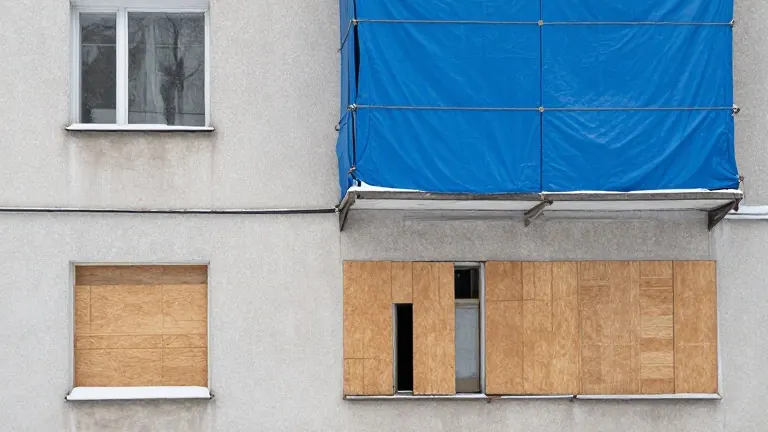
Many residents cannot afford the wait. Shattered openings are often covered temporarily with fiberboard or tarps. Some boards have small openings fitted with Plexiglas to let in daylight. Without proper sealing, apartments are exposed to cold, damp, and mold, a risk that increases during power outages.
The scale of the housing damage is massive. The World Bank estimates that 3 million housing units were destroyed or badly damaged by the end of last year. This damage adds $90 billion to Ukraine’s reconstruction needs. Temperatures in Kyiv fell to minus 20 degrees Celsius, or minus 4 degrees Fahrenheit, during the previous winter.
Industry groups are working to train a new generation of workers. A vocational college in Kyiv opened a European Union-funded facility in March. Twenty-six 10th graders have started a three-year program to become window, door, and facade installers. The program was established after professional associations lobbied the government to formally recognize window installation as a profession.
Students practice around mock window openings built from brick, cinder block, wood, and synthetic materials. Their classes are frequently interrupted by missile and drone alerts. Instructor Volodymyr Tserbii hopes these apprentices will help rebuild the country. Orlenko said graduates can expect starting salaries of around $900, a figure on par with law graduates due to the acute skill drain.
Government planners estimate that repairing the country’s damaged homes, schools, roads, power plants, and other infrastructure will take at least a decade. For families like Horban’s, the wait is immediate. Her apartment lacks gas, forcing the family to cook on a portable cylinder. A leaking kitchen roof has added to the damage. Her toddler son, Viacheslav, asks if more bombing is coming, using the words “bam bam” to describe explosions. “This is not life, this is surviving,” Horban said.