Peru records 1,261 femicides in eight years as Pope Leo XIV demands protection for women
The Peruvian pope addressed the rising gender-based violence rate during his visit to Lima, urging the local church to respond with truth and justice.
By Lorenzo Patterson ·
Pope Leo XIV addressed the rising rate of gender-based violence in Peru on Thursday, calling for the protection of women as he resumed his duties after an emotional homecoming the previous day.
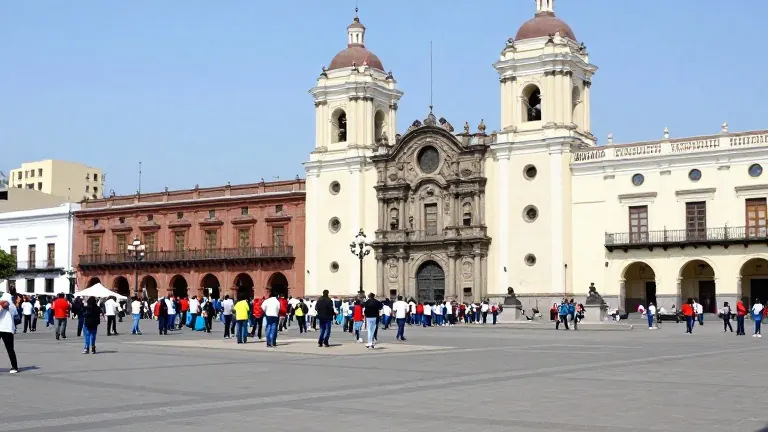
The 71-year-old pontiff, who served as a missionary priest and bishop in the country for two decades, arrived in Lima Wednesday. He spent the day singing with crowds in the Plaza Mayor and at a stadium vigil. Vatican estimates placed the attendance at 60,000 inside the stadium and 300,000 outside. He also met with bishops and six survivors of clergy sexual abuse.
The visit follows his election in 2025 and a recent lung cancer surgery last month. Despite his health history, the pope climbed a steep flight of stairs on Thursday morning without visible difficulty. He told the assembled bishops that some had doubted his ability to make the trip. "But God is great and his grace is bigger than all of us and I'm very happy to be here with you," he said.
In a speech to the public, Leo denounced the culture of "machismo" and violence against women. He stated that the issue contradicts Christian teaching regarding the equal dignity of men and women. The pope noted that poor, Indigenous, and Afro-Peruvian women face double penalties in this regard. He called for all women to be valued, protected, and respected.
The National Institute of Statistics and Informatics recorded 1,261 femicide victims between 2016 and 2024. During that eight-year period, the number of women killed because of their gender rose by 44 percent. Nicole Cruz, a witness at the plaza, said the increase suggests the problem is worsening. "While we've made progress with women's suffrage and in being heard more, femicides are still on the rise," Cruz said.
Leo also directed the Peruvian bishops to model their vocation on St. Turibius de Mogrovejo, the first archbishop of Lima. Mogrovejo is known for traveling to remote communities and studying Indigenous languages to teach the faith. Leo told the bishops that their role involves entering people's homes, accompanying the sick, and reaching out to vulnerable communities that rarely have a voice.
The pope identified clergy sexual abuse as a painful reality in the Peruvian church. He instructed the hierarchy to respond with truth, justice, and forgiveness. "We must respond as Jesus would, with truth, justice, forgiveness, making amends and an ever more resolute commitment to fostering a culture of prevention and protection for the weakest in light of such crimes," Leo said.
Following his speech, Leo met with six victims for one hour. The group included former members of the Sodalitium Christianae Vitae, a movement that Pope Francis suppressed last year after an investigation found sect-like abuses of power and financial mismanagement. The Sodalitium was founded by Luis Figari. Former members first complained to the Lima archdiocese in 2011 about abuses. Concrete action followed only after victims and journalists published a book in 2015.
José Escardó, a former Sodalitium member and whistleblower, waited outside the pope's residence to voice concerns. He said the church has not punished clergy crimes effectively and that Leo has not responded to victim letters for over a year. "These are not sins, they are not a mistake, that is an offense. These are crimes, and as such they must be punished," Escardó said. The online database BishopAccountability has identified 77 priests, brothers, seminarians, and laypeople in Peru who have been publicly accused of sexually abusing minors. The organization states that number is likely a small fraction of the total.