Nvidia Slides as New Tariffs and Inflation Data Hit Markets
Stocks reversed Monday's rally as the PCE index rose to 3.8% and the Trump administration announced new duties on major trading partners.
By Nikolai Morales ·
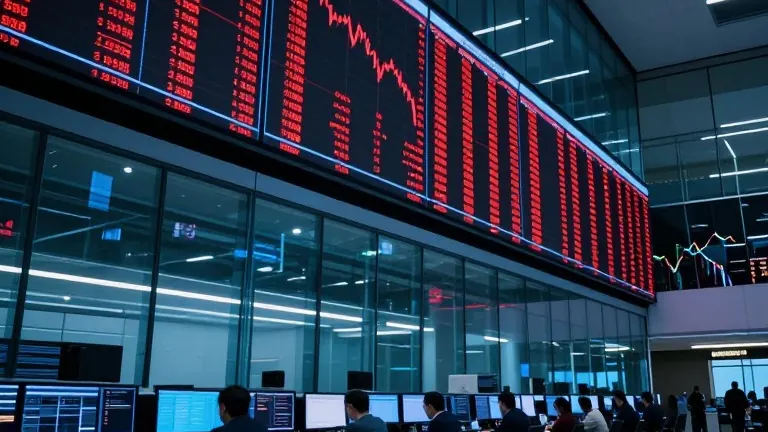
U.S. stocks plunged on Wednesday, wiping out the historic gains recorded the previous day. The Nasdaq 100 index dropped more than 4%, while the S&P 500 lost nearly 3% and the Dow Jones Industrial Average fell 900 points. Nvidia shares slid 7%, leading the retreat among technology firms.
The market had staged its largest one-day rally since April 2025 on Monday. That surge followed the announcement that Jensen Huang had returned as Nvidia's CEO. The news briefly calmed investors who had worried about the stability of the AI sector amid a scandal involving Huang's personal life.
The positive momentum evaporated quickly. Deutsche Bank strategists noted that a risk-averse tone returned within 24 hours. They observed that the recent declines raised questions about whether the sell-off would continue. Before Monday's spike, the Nasdaq 100 had entered correction territory. Wednesday's drop pushed the index into bear market status, defined as a fall of at least 20% from its recent high.
Shares of semiconductor and computer memory companies suffered the largest losses, falling between 7% and 10% in early trading. Anthropic, a frontier AI developer that went public last week, also weighed on sentiment. After a debut that saw shares close 17% higher on Friday, the stock fell for three consecutive days. It now trades at $78, roughly 25% below its first-day closing price.
The Federal Reserve's preferred inflation measure added to the pressure. The personal consumption expenditures index rose to 3.8% in October, up from 3.6% in September. Core inflation, which excludes food and energy, climbed to 3.3% from 3.1%. This trend suggests that high energy costs are spreading to other parts of the economy.
Fed Governor Christopher Waller told CNBC that he is "very, very concerned about inflation" and that it is "headed in the wrong direction." He argued that the central bank might need to hike rates by 0.50% to "shock people" rather than the standard 0.25%. The Fed will announce its next rate decision on Dec. 9.
Trade policy also contributed to the decline. The Trump administration unveiled new tariffs on the European Union, China, Japan, and a dozen other partners. Inga Fechner, a senior trade economist at ING, wrote that U.S. protectionism is becoming harder to reverse. Sarah Bianchi, chief strategist at Evercore ISI, noted that investors had expected these tariffs to arrive, though perhaps not with such immediacy.
A spokesperson for China's Commerce Ministry called the new duties "political manipulation" and said tariff wars serve neither side. Investors are likely to reduce risky positions before the Thanksgiving holiday, as markets will be closed Thursday and open for only a half-day Friday. Mortgage rates currently hover above 7%, and higher borrowing costs could further strain consumers.
More Business · Business Complaints · Report a business · Got a Story?