Jury convicts man in Los Angeles wildfire that killed 12
Jonathan Rinderknecht faces a mandatory minimum of five years in federal prison after being found guilty of arson on both counts.
By Nikolai Morales ·
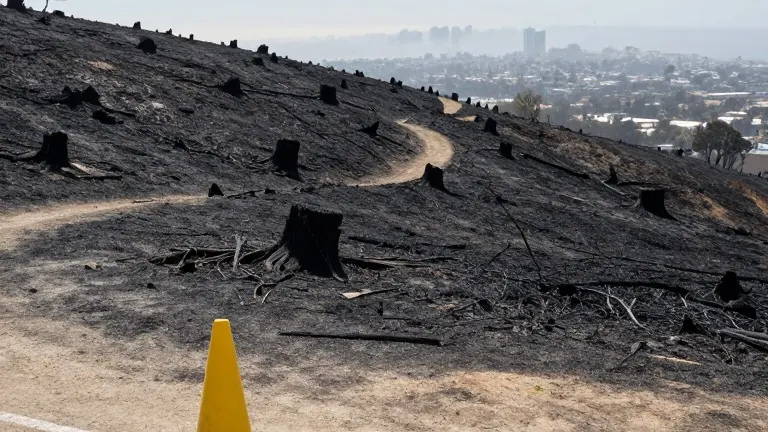
A federal jury in Los Angeles found Jonathan Rinderknecht guilty of starting the wildfire that swept through the Palisades and Malibu in early 2025.
Rinderknecht, 30, was convicted Friday on two counts: destruction of property by means of fire and arson. The first charge covers the initial blaze, known as the Lachman Fire, which ignited on New Year's Day 2025. The second charge covers the larger Palisades Fire that erupted five days later on Jan. 7. The fire killed 12 people and destroyed entire neighborhoods.
The verdict concludes a second attempt to try the case. A first jury deadlocked 10 to 2 in favor of acquittal after a two-week trial in June. Prosecutors dropped a third charge of timber set afire before filing a new indictment for the retrial. Rinderknecht had pleaded not guilty to both federal charges.
His sentencing is scheduled for March 17, 2027. Each count carries a mandatory minimum sentence of five years and a maximum of 20 years in federal prison. Rinderknecht showed little visible reaction in the courtroom. He hugged his attorneys before leaving.
Defense attorney Steve Haney said the team was disappointed in the outcome but respected the jury process. He noted that the jurors clearly gave the case a great deal of consideration. Haney said they would review all options for an appeal at the right time.
Juror No. 3, who went by the name Cameron, said he was the only one who believed Rinderknecht was not guilty at the start of deliberations. Another juror was undecided, while the other 10 believed he was guilty. Cameron said it took a lot for him to be convinced otherwise. He said he now agrees Rinderknecht is guilty.
Cameron identified Rinderknecht's own testimony as the strongest evidence pointing to a guilty verdict. He stated that Rinderknecht said he was up on the hill, did not smell a fire, and did not see fireworks. Cameron noted that no one else was on the hill that night.
Prosecutors presented digital forensic data and expert testimony in this second trial. They focused on placing Rinderknecht at the fire's origin area. Photographs showed his car parked at the base of a trail leading to the ignition point. Cellphone tower data tracked his movement on the hill. Fire detection cameras established the time window for the blaze. Experts eliminated other ignition sources, including fireworks.
Assistant U.S. Attorney Mark Williams said Rinderknecht was acting erratic and angry in the hours before the fire. He quoted, 'He was mad at everything, and frustrated.' After the fire began, Rinderknecht called 911 more than a dozen times while walking down the hill. He also asked the AI chatbot ChatGPT if he was at fault for a fire lit by his cigarettes. Prosecutors said this was part of an alibi he was creating.
The defense argued the fire scene could have been compromised because the area was publicly accessible until Jan. 7. Haney called a retired U.S. Forest Service fire investigator who argued the government had the origin area wrong. He pointed to missing cell data and a neighbor who saw teenagers running from the trailhead. Haney told jurors to disregard character evidence like angry text messages. He presented fireworks as an alternate explanation, noting witnesses heard a loud bang from the hill. Prosecutors countered that thousands of camera images from the evening showed no fireworks in the sky above the hill.