Harvard physicists calculate lunar water limits at 10,000 residents
New research indicates that current estimates of accessible moon water support a town of that size for centuries, but only a city of one million for a single century.
By Nikolai Morales ·
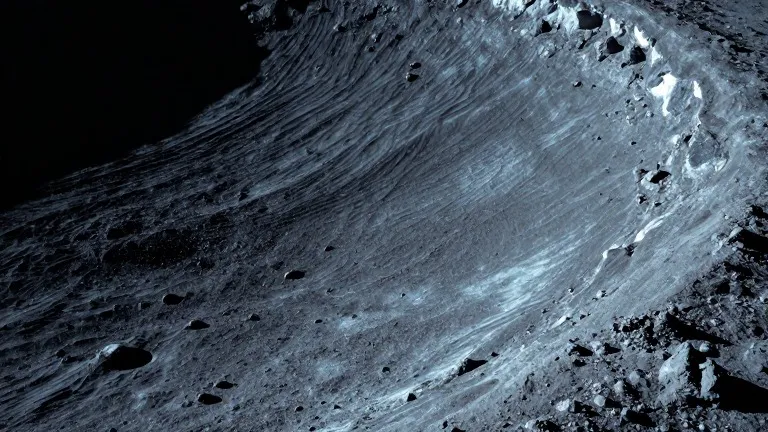
Elon Musk and Jeff Bezos have both pitched large-scale lunar settlements in the coming decades. A new study published this week argues the moon does not hold enough water to support those ambitions for long.
Martin Elvis, a senior astrophysicist at Harvard University's Smithsonian Astrophysical Observatory, and Jonathan McDowell, an honorary professor at the Durham University Space Research Centre, analyzed the resource constraints for lunar cities. Their paper in Frontiers in Space Technologies evaluates two critical inputs: power and water. The researchers found that solar and nuclear energy sources are sufficient to sustain one million people. Water presents a tighter constraint.
Current scientific estimates suggest the moon contains approximately one billion tonnes of water, mostly in permanently shadowed polar regions. Assuming that total, a population of one million could last only 100 years. This calculation assumes a 98 percent water recycling rate, the standard achieved on the International Space Station. Elvis noted that the total volume is modest in context. He compared the reserve to an aquarium the size of Central Park filled until the Statue of Liberty is just underwater. "It's a small lake," Elvis said, "and a small lake is not going to supply a big city for very long."
A settlement of 10,000 people would fare better under the same assumptions, remaining sustainable for centuries. McDowell stated that covering the moon with cities like in science fiction requires finding new water sources because the current reserves are insufficient. "If you want to cover the face of the moon with cities, like in the best science fiction, then you have to find a way to get the water there, because it's not there right now," he said.
The researchers acknowledge their baseline may be optimistic. Elvis believes the one billion tonne figure is likely 20 or 30 times too large. He estimates that only one-third to one-half of existing water is recoverable. His best guess for usable water is about one percent of the original figure, which would reduce the 100-year lifespan of a million-person city to one year.
Gordon Osinski, a professor of planetary geology at Western University in London, Ontario, noted that satellite measurements carry uncertainties. He believes the water exists but requires ground confirmation. Osinski suggested the water may resemble Arctic permafrost, consisting of sub-millimetre ice crystals mixed into soil that are difficult to extract. The findings do not rule out lunar habitation. McDowell said the results should not be viewed as discouraging. "The truth is never negative," he said. "What's negative is to actually go and try and do something that isn't going to work."
Source: CBC News